
Wohlauf Würdige Brüder, Schreitet Voran
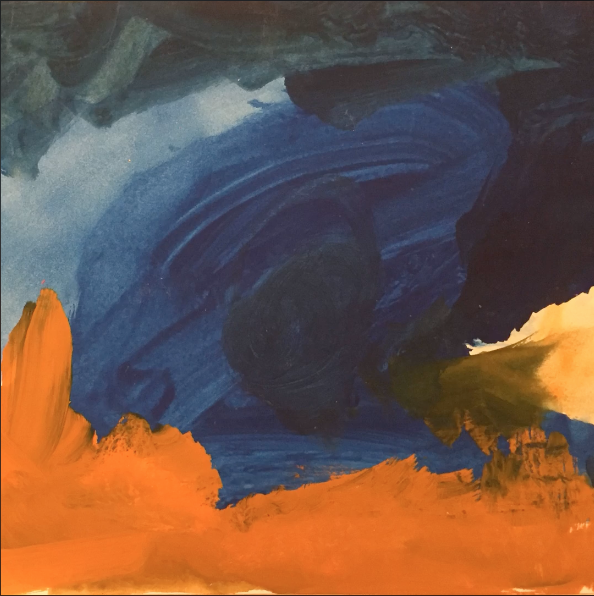
Musical Analysis
Piano Improvisation — February 2018
Wohlauf Würdige Brüder, Schreitet Voran is an extended piano improvisation of approximately twenty-five minutes. Unlike a conventionally composed work built around a predetermined formal scheme, the piece unfolds as a continuous musical process: ideas emerge, develop, recede and return in altered form.
The tonal language remains strongly rooted in traditional harmony. Across the work, C major emerges as the principal gravitational centre, while neighbouring tonal regions — including G major and passages with a distinctly darker minor colouring — create contrast and temporary instability. The music repeatedly moves away from tonal security before finding its way back towards more stable harmonic ground.
This alternation between stability and uncertainty is one of the defining characteristics of the improvisation. Major and minor are not treated as rigidly separated emotional worlds; rather, the music moves between brightness, introspection, tension and renewed affirmation. The result is less a sequence of clearly divided movements than a continuously evolving psychological landscape.
Rhythmically, the work possesses an underlying forward impulse. Its approximate pulse lies in a moderate range, but the expressive character is governed less by a fixed tempo than by changes in density, articulation and intensity. Quieter, more contemplative passages are followed by increasingly forceful episodes, producing a sense of progression over the long span of the work.
Particularly notable is the large-scale dynamic trajectory. The later sections acquire greater weight and sonority, and the final part of the improvisation is among its most energetic. Rather than gradually dissolving, the work appears to gather strength as it progresses. This gives the title — Wohlauf Würdige Brüder, Schreitet Voran — an interesting musical resonance: the underlying gesture is one of movement, persistence and advancement.
At the same time, the piece does not behave like a march in the conventional sense. Its forward motion is repeatedly interrupted by reflection, harmonic detours and moments of uncertainty. Progress is therefore not represented as a straight line. It emerges through alternation: movement and hesitation, confidence and doubt, tension and resolution.
Heard as an early work within the later Ordo ab Chao context, the improvisation already reveals an important characteristic of the cycle: musical form is discovered through the act of playing rather than imposed in advance. Structure emerges from the accumulation and transformation of musical ideas. Order is gradually drawn from material that initially appears free — a principle that would become fundamental to the larger artistic conception of Ordo ab Chao.
Origins & Context
Wohlauf Würdige Brüder, Schreitet Voran was my first professional recording of an extended piano improvisation. At the time, however, there was no Ordo ab Chao. The idea of a cycle — and its title — would emerge only much later.
In March 2017, I had left my career in private banking by choice, without another position waiting for me. I began building an independent professional existence and founded Wegmann Advisory. It was a period of considerable uncertainty. I was responsible for supporting my family and caring for my children while simultaneously trying to create a viable professional future whose eventual form I could not yet foresee.
During the course of 2017, the situation gradually began to stabilise. I developed my own investment strategy and also assisted my mother with her online business. By the end of the year, what had initially felt precarious was beginning to resemble a possible way forward.
My daily life had changed as well. I was no longer commuting to Zurich every morning and was spending considerably more time at home. I began sitting down at the piano increasingly often — not to practise repertoire and not with the intention of composing predetermined works, but simply to improvise.
From this came the idea of creating a kind of musical diary. My original intention was to enter the recording studio every few months and preserve these spontaneous musical moments professionally. In reality, the intervals between subsequent recordings would eventually become much longer.
In February 2018, I went into the studio for the first time. There was no score, no predetermined structure and no agreed duration. I would begin playing and stop when I felt that the music had reached its end.
I played for almost twenty-five minutes.
When I stopped, I remember feeling completely emptied out and, at the same time, profoundly fulfilled. I left the studio that evening extraordinarily happy. I had gone there simply wanting to make a professional recording of an improvisation. Only later would I understand it as the beginning of something larger.
The title also emerged retrospectively. At the time, I knew that I was to be received into the 32nd degree of the Ancient and Accepted Scottish Rite in April 2018. When I subsequently listened to the recording, the final section struck me as distinctly march-like. In my imagination, it became an image of brethren moving forward together with determination and purpose.
From that association came the title: Wohlauf Würdige Brüder, Schreitet Voran — Arise, Worthy Brethren, March Forward.
What began in February 2018 as a single experiment in recording an improvisation would, only in retrospect, become the first work of Ordo ab Chao.