
Die Reisen Eines Gesellen
Origins & Context
Le Clown occupies a singular place in my musical work. I composed the piece at the age of fourteen, long before the improvisations that would later form Ordo ab Chao. Unlike those works, Le Clown was conceived as a composition from the outset.
The music is closely connected to my mother. After my parents divorced, we lived in modest circumstances. She worked extraordinarily hard, eventually building a successful career at the Swiss National Bank. In the evenings, when she returned home exhausted, she would sometimes take a bath and ask me to play this little piece for her on the piano. It became her favourite.
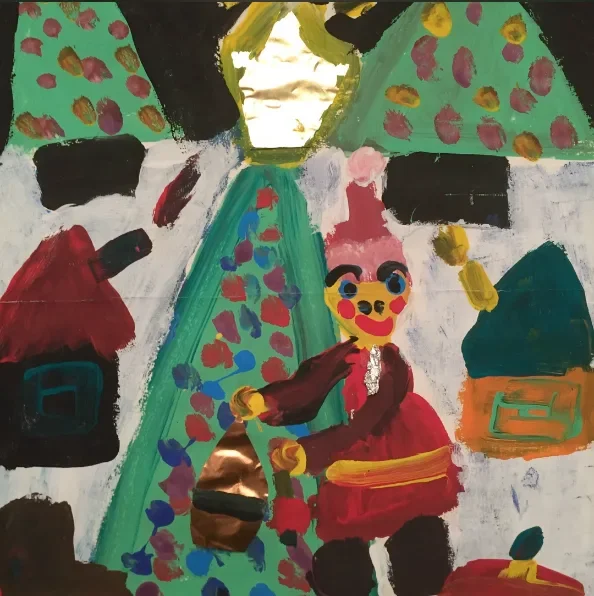
Its title and visual identity came much later. The artwork was painted by my daughter, Amelie Sophie, when she was still in kindergarten. Years later, the original painting entered a conversation within my Masonic circle. A woman whose late husband had been an important mentor in my own Masonic journey saw the figure in the painting as a clown. The name stayed with me: Le Clown.
The image subsequently acquired another personal association through my involvement with Shriners International. The red nose of the clown evokes a tradition of deliberately playful self-presentation: accomplished adult men willing to make themselves look slightly ridiculous, particularly in the presence of children. To me, there is something serious behind that gesture — a willingness to surrender status, to be looked at differently, and to meet vulnerability with humour rather than distance.
This also gave the title a meaning that seemed to belong to the music. A clown brings joy to others, yet behind the smile there may be solitude. The piece itself is musically simple. Perhaps that simplicity is precisely why it has remained with me.
In December 2022, almost four decades after composing it, I finally recorded Le Clown in the studio.
Musical Analysis
Le Clown is built around a deliberately simple tonal language, with C major providing a clear and remarkably stable centre throughout the piece. Rather than seeking harmonic complexity or virtuosity, the composition derives its character from melodic directness, repetition and subtle variation within a familiar tonal space.
This simplicity gives the music an almost childlike immediacy. Yet its emotional character is less straightforward than its major tonality might suggest. Beneath the apparent brightness lies a quiet sense of melancholy — movement without urgency, warmth without exuberance.
This ambiguity would later resonate naturally with the title Le Clown: the figure who entertains and brings joy to others while concealing a more solitary inner world. The association was not part of the composition when it was written, but it became an unexpectedly fitting interpretation of the music many years later.
Composed at the age of fourteen, Le Clown stands apart from the later improvisational works. Its significance lies not in complexity, but in the clarity and persistence of a simple musical idea that has remained meaningful across decades.